ArticlesWriting tools
What an AI message checker can check, and how to do it yourself
An AI message checker gives you a second read on a message you already wrote. What it can tell you, the line it should not cross, and the seven-step version you can run yourself in under a minute.
By Samet Durgun · Co-founder of Subtext · 17 min read
· Updated October 3, 2026
If you searched for an AI message checker, you probably already have the message. It is sitting in the text box, you have read it six times, and nothing is obviously wrong with it. It just feels off. Too cold, or too much, or defensive in a way you cannot point at.
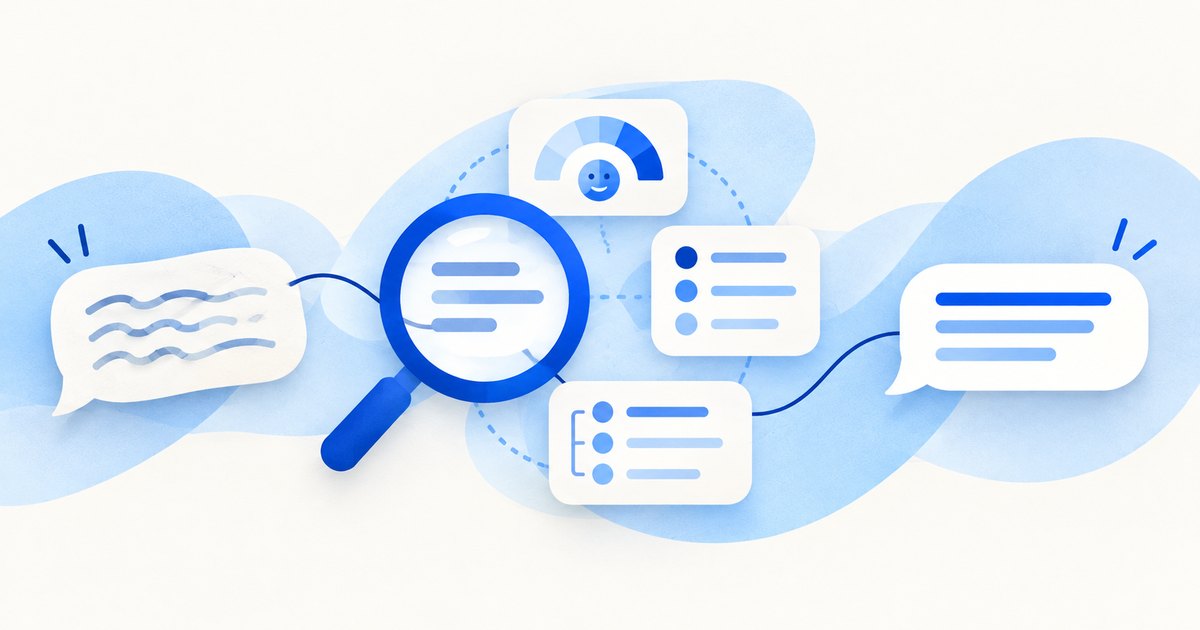
An AI message checker reads a message you have already written and shows you how the wording may come across before you send it. Some rewrite afterwards. The checking is the part that matters, and it is the part most tools skip.
I co-founded Subtext, which centres on this exact moment, so I am not neutral about the category. What the Subtext app is, who it’s for, and when to use it is a separate piece. What I can be useful about is the narrower question of what software can tell you about a message, and what you still have to decide yourself. I link every research claim below to its source.
What a message checker can check, and the line it should not cross
A checker can analyse the language in front of it. Whether the wording reads formal or casual, direct or indirect, warm or distant. Whether a phrase states the other person’s motive as a fact. Whether there are three apologies inside a two-line refusal.
What it cannot do is verify what anybody privately feels. That includes Subtext, which flags what the wording could reasonably suggest, not what you feel.
Take a two-word draft: “Fine. Do whatever you want.” A checker can reasonably say that “Fine” is clipped and that “whatever you want” reads as withdrawal. It cannot establish that the person who wrote it is angry. Those are different claims, and a lot of tone-detection marketing crosses between them without saying so. I went through the evidence on that in a separate piece on what AI does and does not know about tone.
For a message you are about to send, mind-reading is not what you need anyway. You need a second reader, because you cannot be one for your own draft.
Why rereading your own draft does not work
Kruger, Epley, Parker and Ng ran five experiments on this in 20051, and people quote the paper far more often than they read it.
The largest of the five had 154 pairs of students write statements meant to convey sarcasm, seriousness, anger or sadness, then predict whether their partner would identify the intended tone. Senders expected to land 88.8 percent of them. They landed 70.4 percent.
The gap is the finding, and the authors are careful about what it does not mean. Accuracy in their first experiment was 84 percent, and they write that it would be “misleading to suggest from these data that people are poor at communicating sarcasm over e-mail.” Their own summary of what the gap does mean:
Their own words “However able people are, they are not as able as they believe.”
Kruger, Epley, Parker and Ng, 2005
Three details make this harder for a sender. Friends were no more accurate than strangers, and just as overconfident, so writing to someone who knows you well does not close the gap. Emoticons do not close it either. A follow-up reported inside the same paper manipulated whether senders could use them and found that “overconfidence did not differ between those who were using emoticons and those who were not.” And the widely circulated claim that people read tone correctly 56 percent of the time stretches a narrow result. The authors print the 56.0 on Figure 1 of the second study, and it is email accuracy on a binary sarcastic-or-serious judgement among 29 pairs, which the text calls indistinguishable from chance. It is not a general rate for reading tone, and I wouldn’t repeat it as one.
One limit before the steps. This is 2005 research on email. The authors expected the mechanism to extend to chat and instant messaging and said so, but nobody has rerun it on modern texting. Treat the mechanism as well established and the exact percentages as belonging to email.
What your message reliably carries, and what it loses
Holtgraves2 gives the most useful modern numbers. Senders wrote text messages conveying one of 22 emotions without naming them. Readers identified the emotion by free response 20.1 percent of the time, and 46.3 percent with multiple choice. When they got it wrong, they still landed in the correct positive or negative valence 84.5 percent of the time in the free-response study and 90.6 percent in the multiple-choice study.
That produces one instruction for a sender. The reader will almost certainly register that something is off. They will probably get the reason wrong. So you aim the check at the ambiguity that lets them fill in a worse reason, not at hiding the feeling.
Byron’s framework3 predicts the direction of the loss, with positive emails tending to arrive as neutral and neutral ones as negative. It is a theory paper, not an experiment, so weigh it accordingly. Write one notch warmer than feels natural and it arrives at natural.
The seven-step check
There is no validated scientific test for whether a text sounds all right. What follows is a way of creating distance from your own draft. It takes under a minute and needs no app.
These seven steps work through intent, context, the message itself, and a last check before sending. Who is reading it gets its own section right after them.
1. Read it without supplying what you meant
Take the sentence carrying the most weight and read it as though you do not know who wrote it.
“I guess just do whatever works for you.” You know whether that was sincere. Your reader does not. “I guess” can signal reluctance. “Just” can add impatience. “Whatever” can read as withdrawing from the decision.
None of those readings is automatically the right one. They are available to the reader, which is why you check at all.
2. Count the apologies and the hedges
This is the most common defect I see, and both halves have evidence behind them.
Freedman, Burgoon, Ferrell, Pennebaker and Beer4 found across studies totalling roughly 1,880 participants that apologies attached to rejections increased hurt feelings and created pressure to say “I forgive you” without increasing actual forgiveness. Apologetic rejections produced more aggression in a behavioural task. About 39 percent of people spontaneously included an apology when asked to write a good rejection, so the counterproductive move is also the popular one. The evidence is specific to rejections and declines, and I will not stretch it further.
On hedges, Givi, Kirk, Grossman and Sedikides5 ran six experiments, five preregistered, on replying to an invitation with a tentative “maybe” instead of a straight no. Invitees overestimated how much the inviter would prefer the maybe, because they underestimated how much more disrespected a maybe makes the inviter feel. I think their explanation is the part worth sitting with. In their account, the maybe serves the person sending it more than the person receiving it, and motivated reasoning does the rest. That evidence is about invitations, so applying it to any decision you have already made and are dressing as uncertainty is my extension rather than their finding.
In practice, count every sorry, every “sorry to bother you”, every “I hope this isn’t annoying”. Keep at most one, and only where you are apologising for something you did. Then search for maybe, possibly, we’ll see, let me check and get back to you. Some are real uncertainty and stay. The ones to cut are the ones you felt relieved to write.
This count is also the first thing Subtext runs on a draft, because the Freedman numbers suggest the apology you added instinctively is the one you are least likely to notice on a reread.
3. Find the sentence that is about you rather than them
Read each sentence and ask who it serves. “I’ve been meaning to message for ages and I feel terrible about it” is you managing your own guilt in front of someone who now has to reassure you about it. It is a request wearing the clothes of an admission.
This step rests on reasoning alone. Nobody has run the experiment. I include it because it is the most reliable pattern I have found reading thousands of drafts, and because it sits next to something the research does document: an apology that asks for absolution and an apology that acknowledges a cost are different acts, and only the second does anything for the recipient.
The fix is usually deletion. Occasionally it is moving the sentence to the end, where it reads as a footnote and stops being the point.
4. Check whether the request also carries a judgement
Compare “Can you let me know by Thursday?” with “Can you please actually let me know this time?”
Both make a request. The second also comments on the person’s past behaviour. That may be deliberate, and sometimes it should be. More often it arrives because you were frustrated while typing and the frustration found a place to sit.
The word doing the work is usually small. Actually. Again. Finally. This time. Look for those specifically.
5. Check whether the explanation has taken over
Explanations are useful and they quietly turn into defences. It happens most in apologies, cancellations and disagreements. You start with what happened, then why it happened, then why your reaction to it made sense. By the end the reader has received a case for the defence when you thought you were sending an apology.
Delete the explanation for a moment and look at what is left. Is the request still clear? Is the acknowledgement still there? Is the no still a no? If the message collapses without the explanation, the explanation was carrying something it should not have been.
6. Ask whether it adds anything or only asks for a reply
Lew, Walther, Pang and Shin6 crossed response latency with conversational contingency, meaning how directly a message engages with what came before. Contingent replies outperformed generic ones overall, but the effect of speed depended on contingency. A fast reply helped only when it was also contingent, while a fast but generic, scripted-sounding reply was rated the worst of all four conditions, worse than a slow generic reply. Contingency was a precondition for speed to pay off at all, and it didn’t cushion slowness.
So readers evaluate a message that engages with the conversation on its content, and one that only prompts for a response as a demand for something you feel owed. “?” and “hello?” are the pure form. “Just checking you saw this” does identical work in a better coat.
A fast test is to delete the last line. If the message still says something, the last line was a prompt and it can stay deleted.
7. Read it out loud in the wrong tone
This is the only step here with an experiment directly behind it, and the result is more specific than the advice you normally hear.
In the fourth experiment of the Kruger paper1, 54 students typed out sarcastic and serious statements to send by email, then read each one aloud into a tape recorder before predicting how well their partner would decode it. Half read each statement in the tone they had intended. Half read it in the opposite tone, saying the sarcastic ones seriously and the serious ones sarcastically.
The second group stopped being overconfident. In the paper’s words, “the phenomenology manipulation completely erased participants’ overconfidence.” The first group, reading the statements in the tone they had intended, stayed overconfident, as participants in the earlier studies had been.
So reading your draft aloud the way you meant it does nothing, which is awkward for the standard version of this advice. Read it aloud in the tone you are afraid of instead. Say it flatly. Say it coldly. Say it as though you were annoyed with the person. If it survives that, send it. If it becomes a different message in your mouth, that reading was sitting in the text the whole time and you could not see it.
One experiment, 54 people, on email. It is still the best-evidenced item on this page. It is also the closest description of what Subtext does when it reads a draft, which is a pass through your words in a voice that is not the one in your head.
Then read it once as the person receiving it
The reading a message gets depends on who is holding it, and they are overconfident too. In the third Kruger study, the largest, email readers believed they had identified the sender’s intended tone 89.3 percent of the time and were right 62.8 percent of the time1. Whatever they decide your message meant, they will not be checking.
Who they are shifts the odds. Sillars and Zorn7 documented a negative intensification bias in workplace email, where receivers rated messages more negatively than uninvolved observers did and were only weakly anchored to the message’s actual features. The effect was stronger in poor communication climates and among people lower in the hierarchy. Kingsbury and Coplan8 found socially anxious readers interpret ambiguous texts more negatively, across samples of 215 and 353.
So if you are messaging someone junior to you, or someone you have been tense with, or someone anxious, the sharpest available reading of your draft is a likely one rather than a paranoid one. Read the message as them, in that state, and see whether it survives.
The popular version overshoots, so I’ll say this plainly. The evidence does not show everyone defaulting to the worst reading of everything. It shows that who is reading and what the relationship is like at the time predict negative interpretation.
Four more worked examples
Four more, in different registers, checked the same way. No study backs any of these, the same as the two-word draft and the Thursday request above. They are editorial calls, not findings.
A friend reschedules for the third time and you reply, “Sure, whenever works, no worries.” “Sure” and “no worries” read as easy agreement on their own. Stacked on a third reschedule, the same words can also read as absorbing the inconvenience while quietly keeping count, and your friend has no way to tell which one you mean. “This week doesn’t work for me now, but let’s find a time that actually sticks next week” says the same thing without asking them to guess.
You have a 5pm deadline and send “Can we sync on this when you get a chance?” It reads as no rush to whoever gets it, when what you meant was today, ideally within the hour. “When you get a chance” leaves the timing up to the reader to work out. “Can we talk today? I need to send my update by 5pm and I’m missing what you have” names the deadline outright.
A refusal drafted as “I’m so sorry, I really don’t think I can take this on right now, but let me know if anything changes and I will try to help however I can” is what step two is looking for. The apology, the hedge in “I really don’t think,” and “let me know if anything changes” all reopen a door the sender meant to close, and the reader has to guess whether the no is real. “I can’t take this on. Ask me again next month if it’s still open” is the same decision, said once, with nothing left to search for.
A flat “K” can read as upset, or as someone typing with one hand on the stairs, and a common first draft in reply is “Sorry if I did something wrong, just let me know and I’ll fix it.” That apologizes for an offense you have not identified and hands the reader the job of naming it. A short reply from someone you are already tense with is a more likely bad sign than the same reply from someone neutral, but it is still a guess, not a fact. “Your last text read a little short to me. Is this a good time to talk, or is later better?” turns the guess into a question.
Message checker or message rewriter
The two can run on similar models underneath. Subtext runs both in a fixed order. It reads the draft and shows what it found first, then offers rewritten versions underneath in the same reply, or tells you the draft is already fine. The useful moment happens at a different point.
| Message checker | Message rewriter | |
|---|---|---|
| Starts with | A message you already wrote | A draft or a prompt |
| Main job | Show how the current wording may read | Produce different wording |
| Useful when | You cannot name what feels off | You already know what you want changed |
| Main risk | Treating one interpretation as fact | Replacing more of your voice than needed |
| Good outcome | You understand your own draft | You get a better alternative |
Back to “Fine. Do whatever you want.” A rewriter might hand you “Sounds good, go with whichever option works best for you.” That is smoother, and it is a different message. Maybe you are frustrated and want some of that to survive. Checking first lets you see the effect before you decide whether to delete it.
Can ChatGPT check a message before you send it
Yes, if you ask it the right way. The failure mode is that a general assistant will solve the easier problem and hand you a rewrite before it has told you anything.
Separate the two explicitly:
Read this as the person receiving it. Do not rewrite it yet. Tell me which phrases could read as colder, more defensive or more intense than I probably intend, and explain why each one does.
Then paste the draft, and add the relationship and the previous message if either changes the meaning.
For an occasional difficult text that works well. What Subtext removes is the setup, which matters mainly because you are least able to construct a careful prompt at the exact moment you need one.
What your phone already does
Apple Intelligence Writing Tools rewrite selected text and offer Friendly, Professional and Concise, plus a “Describe your change” box for anything more specific9. Google’s Magic Compose suggests replies and rewrites drafts in different styles inside Google Messages on supported devices10. Samsung’s Writing Assist generates text, changes writing style and checks spelling and grammar on supported Galaxy phones11. Grammarly goes furthest into detection, and its tone checker states that it analyses word choice, phrasing, punctuation and capitalisation12.
All of these are good when you know what you want. “This is too formal, make it more casual” is a solved problem and it is free on hardware you already own.
The harder version is “I do not know what is wrong with this, does it sound all right.” That question is where checking and changing stop being the same job. It is also why most tone checkers never check your tone: they skip straight to the change.
How Subtext runs the check
Subtext starts from the message you are writing and shows how it may come across before you decide whether to change anything. You can write from scratch, paste a draft, or add a screenshot of the conversation for context.
The analysis reads your draft’s tone and clarity and flags wording that could land as unclear, harsh, passive or easy to misread. Underneath, it offers alternative wording, and you can tap shorter, warmer, more casual, or add confidence, and it rewrites while keeping your voice13.
A screenshot does a different job. It supplies conversation context so the reply fits the exchange. I want to be precise about that. The trigger and emotion analysis runs on your own draft. A screenshot of what somebody else sent is context for your reply, not proof of what they privately feel, and no tool including this one can establish that from a screenshot.
The order is the part I care about. Read the draft. See what may be landing differently from what you meant. Then decide whether anything needs changing. Sometimes the useful result is that the message was already fine.
Try Subtext in your browserScan it with your phone camera to install.Try Subtext in your browser
What none of this catches
Three limits, and they matter more than the steps do.
The check is structural. It finds apologies, hedges, prompts, judgements and self-serving sentences. It has no opinion on whether the thing you are saying is correct, fair or worth saying, and a well-worded message can be wrong in every way that counts.
The reader brings their own weather. A 2025 preregistered study of 51 couples14 found people partly read their own current mood into their partner’s messages. Nothing in your draft controls that.
And the check assumes the problem is the wording. Sometimes it is not. If you are rewriting the same message for the ninth time, or sending three follow-ups to find out whether someone is annoyed, the wording has stopped being the thing under strain. I have written separately about the research on texting anxiety and on reading anger into ambiguous messages, and both are more use than a better draft. If it is persistent enough to be shaping your days, a doctor or therapist is a better resource than an article by someone who makes an app.
Common questions
What is an AI message checker? It analyses a message you have already written and shows how the wording may come across before you send it. Depending on the tool that can cover tone, clarity, formality, ambiguity, or phrases likely to be misread. Some also offer rewrites afterwards.
Can AI tell if my message sounds rude? It can identify wording that may reasonably read as blunt, dismissive or accusatory. It cannot guarantee that a particular person will find it rude. A useful checker names the specific wording that produced the reading rather than handing you one label.
Is a message checker the same as a tone checker? They overlap. A tone checker typically names qualities in the writing, such as formal, confident or accusatory. A message checker can also look at clarity, specific wording and conversation context.
Can AI know how someone feels from a text? It can analyse language and offer plausible readings. A text alone does not establish the writer’s private emotional state, and confident claims about what somebody really feels go beyond what the words support.
What is the difference between a message checker and an AI texting app? “AI texting app” is a broad term covering dating reply generators, writing keyboards, chatbots and automatic reply tools. A message checker does a narrower job. It analyses something you already wrote, before you send it.
Think I have read a study wrong, or know research on this I have missed? Tell me on LinkedIn.
Samet Durgun is the co-founder of Subtext, an app that catches the emotional tone of your messages and rewrites them in your own voice. He’s based in Berlin.
Sources
Every link goes to the primary source where one exists, numbered in order of appearance. Where a step rests on reasoning rather than evidence, this post says so instead of borrowing authority from a nearby study. Quotations are verbatim.
- Kruger, J., Epley, N., Parker, J., & Ng, Z.-W. (2005). Egocentrism over e-mail: Can we communicate as well as we think? Journal of Personality and Social Psychology, 89(6), 925-936. Five experiments. Study 1 N = 12, Study 2 N = 60, Study 3 N = 308 in 154 pairs, Study 4 N = 54, Study 5 N = 58. Funded by the University of Illinois Board of Trustees and NSF grant SES-0241544. The widely quoted 56 percent figure is the email accuracy printed on Figure 1 in Study 2 rather than a number in the text, a binary sarcastic-or-serious judgement among 29 analysed pairs, not a general rate for reading tone.
- Holtgraves, T. (2022). Implicit communication of emotions via written text messages. Computers in Human Behavior Reports, 7, 100219. N = 136 and N = 167.
- Byron, K. (2008). Carrying too heavy a load? The communication and miscommunication of emotion by email. Academy of Management Review, 33(2), 309-327. Theory paper, no sample.
- Freedman, G., Burgoon, E. M., Ferrell, J. D., Pennebaker, J. W., & Beer, J. S. (2017). When Saying Sorry May Not Help: The Impact of Apologies on Social Rejections. Frontiers in Psychology, 8, 1375. Combined N approximately 1,880; findings specific to rejections.
- Givi, J., Kirk, C. P., Grossman, D. M., & Sedikides, C. (2025). Maybe don’t say “maybe”: How and why invitees fail to realize that they should not respond to invitations with a “maybe”. Journal of Experimental Social Psychology, 121, 104814. Six experiments, five preregistered. Findings specific to invitations.
- Lew, Z., Walther, J. B., Pang, A., & Shin, W. (2018). Interactivity in Online Chat: Conversational Contingency and Response Latency in Computer-Mediated Communication. Journal of Computer-Mediated Communication, 23(4), 201-221. N = 131, 2×2 between-subjects design.
- Sillars, A., & Zorn, T. E. (2021). Hypernegative Interpretation of Negatively Perceived Email at Work. Management Communication Quarterly, 35(2), 171-200.
- Kingsbury, M., & Coplan, R. J. (2016). RU mad @ me? Social anxiety and interpretation of ambiguous text messages. Computers in Human Behavior, 54, 368-379. N = 215 and N = 353.
- Apple Support. Use Writing Tools with Apple Intelligence on iPhone.
- Google Messages Help. Draft messages with Magic Compose.
- Samsung Support. Use Writing Assist on Galaxy phones and tablets.
- Grammarly. Writing Tone Detector and Tone Suggestions.
- Subtext. subtext.it, checked August 2026.
- Steinebach, P., Stein, M., & Schnell, K. (2025). Messenger-based assessment of empathic accuracy in couples’ smartphone communication. BMC Psychology, 13, 147. N = 102 in 51 couples; recruitment fell short of the preregistered target.